

Designed for Action.
Built for Intelligence.
Zygy brings together AI-powered signal analysis, regulator-compliant decision workflows, and full audit traceability — in one unified platform.


94%
Average AI decision confidence on critical actions
100%
Of decisions logged with full classification chain
<2 min
Signal to Action Engine alert latency
-
AI classifies each signal against a fixed taxonomy: SEVERE_CHARGE, SUSPECT_IDENTIFIED, WITNESS_FLAG, EVIDENCE_LINK, INCIDENT_NARRATIVE, PROCEDURAL— aligned to jurisdictional standards
-
The Action Engine automatically escalates signals that breach risk thresholds — no analyst needs to manually monitor dashboards.
-
Every automated action carries a confidence score, rationale, and signal chain— reviewable by a compliance officer at any time.
-
Human override is always available — analysts can change any AI-recommended decision type before it is logged.

Public Announcement reports are normalized into a single signal schema— no manual data re-entry.
Built-in confidence thresholds act as quality gates— signals below threshold are flagged for human review rather than auto-classified.
Cross-portfolio checks automatically detect when the same entity appears across multiple issues — preventing duplicated investigation effort. To preventing duplicated decisions.
Risk scores are recomputed on every new signal — the Outcome Monitor reflects the latest state in real time, with no manual refresh required.
11
Max cross-portfolio signal overlaps detected (House Crime pair) to Max cross-portfolio signal overlaps detected (Common Actors in Topics )
5
Data source types connected to a single analysis pipeline
-
A single pipeline run in Services flows into Control Tower signals, which generate Action Engine recommendations, which create Work Hub tasks — with no manual bridging.
-
Cross-portfolio correlation ensures that a discovery in one issue (e.g. shared actor in Product A Functional Requirements ) automatically surfaces in the related issue (Product B Functional Requirements) without the analyst having to know to look.
-
Work Hub approvals can be triggered directly from an Action Engine recommendation — reviewers see the full AI rationale, signal chain, and confidence score in context.
-
The Outcome Monitor closes the loop — showing whether actions taken actually moved the risk score and resolved the issue.

3
Platform modules coordinated in a single workflow (Services → CT → Work Hub)
78%
Feature Compliance resolution progress after coordinated action
-
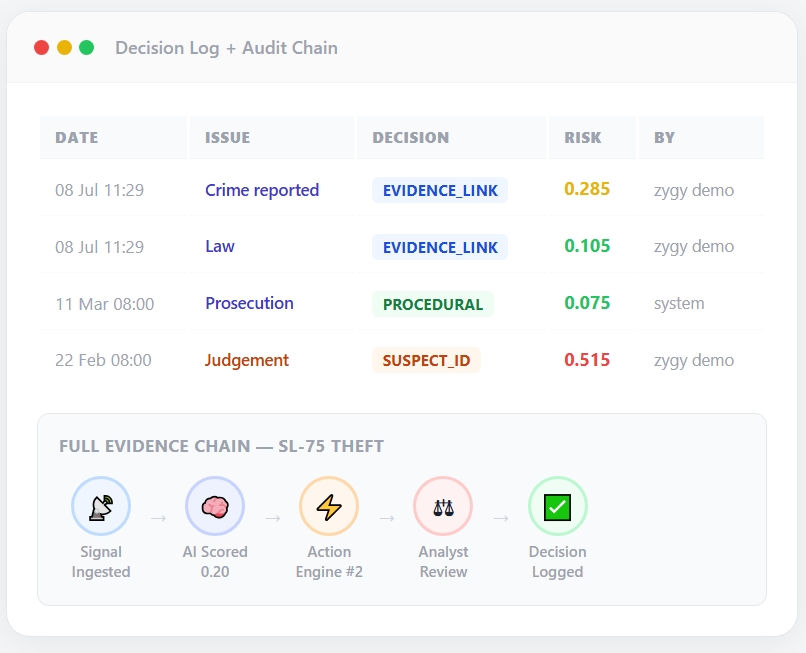
Decision Log records every classification with: decision type, risk score, sentiment, platform source, analyst name, and date — exportable for regulator submission.
-
Action Timeline in each War Room shows every action logged, who logged it, and what changed in the risk score as a result.
-
Baseline vs current comparison in the Outcome Monitor gives a defensible before/after view — key for post-incident reporting and internal review.
-
AI override events are also logged — if an analyst changes a recommended decision, the original AI suggestion, the override, and the reason are all preserved.
9
Decisions in log — each with full classification chain
0
Untracked actions — every event is attributed to a user or system
-
Multi-database architecture— Elasticsearch for search, Neo4j for graph relationships, MongoDB for documents, SQLite for lightweight data — all unified behind a single API.
-
AI model agnostic— currently powered by Azure OpenAI (GPT-3.5-turbo-16k) with the architecture designed to plug in any future model without platform changes.
-
SSO & identity federation— CAS SSO, Google OAuth, and Azure MSAL (OneDrive) supported out of the box. Analysts authenticate once and access everything.
-
Document format interop— PDF, DOCX, XLSX, scanned images all processed via Tika, PDFBox, Mammoth, and Spire.xls — no pre-processing required from users.
-
Streaming & real-time— SSE-based streaming search (port 7201) delivers live AI responses without page reloads, keeping analysts in flow.
