

Intelligent Document Processing Use Cases: KYC, Financial Extraction, and Automated Reconciliation


How is IDP used in Finance and Compliance?
Intelligent Document Processing (IDP) is used in finance and compliance to transform high-friction, error-prone workflows into automated pipelines. The top three use cases include:
KYC Onboarding: Automatically extracting, cross-verifying, and reconciling identities from unstructured documents (passports, utility bills) against global watchlists.
Financial Statement Extraction: Parsing complex, nested tables in Cash Flow statements, Profit and Loss Statements and Balance sheets, complete with automated mathematical reconciliation.
Excel Comparison: Normalizing disparate spreadsheets to instantly flag gaps, detect mismatches, and generate plain-language exception reports.
In the financial and regulatory sectors, operational bottlenecks rarely stem from a lack of data; they stem from the inability to process it accurately at scale. While traditional OCR (Optical Character Recognition) digitizes text, it lacks the cognitive ability to understand business logic.
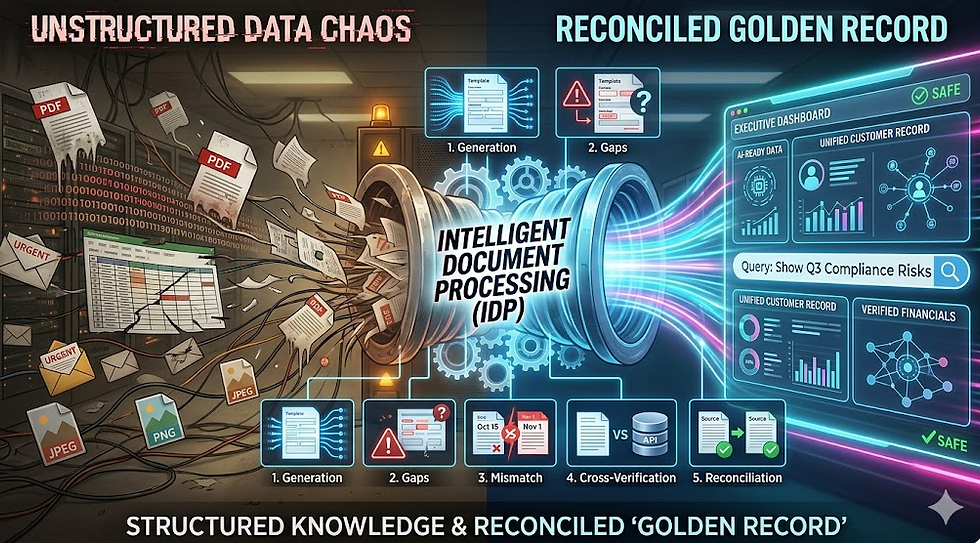
Modern Intelligent Document Processing (IDP) acts as an investigative reasoning layer, turning unstructured document chaos into a unified, queryable "Golden Record."
If you are looking to scale your operations, here is a deep dive into three of the most powerful IDP use cases for enterprise compliance and finance teams.
1. Automating KYC (Know Your Client) Onboarding
The KYC process is notorious for being a manual, high-friction nightmare. Compliance teams must verify identities using a chaotic mix of unstructured documents—from passports and national IDs to utility bills and corporate registry certificates, often in varying languages and scan qualities.
How IDP Solves the KYC Bottleneck:
Intelligent Entity Extraction: IDP categorizes the document type and extracts critical entities (Full Name, Date of Birth, Issuing Authority) regardless of layout or format.
Intra-Document Mismatch Detection: The reasoning engine automatically cross-references documents. It will instantly flag a mismatch if the address extracted from a utility bill does not perfectly align with the address listed on the bank’s application form.
External Cross-Verification: Extracted data is routed through APIs to verify against external ground truths, checking government databases, Anti-Money Laundering (AML) sanctions, or global watchlists in real-time.
The Outcome: What traditionally takes a compliance analyst days of manual review is reduced to minutes. Institutions get a secure, audited "Golden Record" for new clients, drastically lowering the risk of regulatory fines and improving the customer onboarding experience.
2. Deep Information Extraction from Financial Statements
Financial statements—such as balance sheets, and income statements are kryptonite for traditional OCR. They rely on complex, nested tables, footnotes, and highly varied accounting terminology across different organizations.
How IDP Decodes Financial Documents:
Contextual Table Parsing: IDP understands document geometry. It can accurately extract line items spanning multiple pages and recognizes semantic equivalents (e.g., understanding that "Operating Profit," "EBIT," and "Earnings Before Interest and Taxes" all map to the same schema variable).
Mathematical Reconciliation: To guarantee accuracy, the IDP engine performs automated internal gap checks. It recalculates the extracted rows to ensure sub-totals tie out to the grand total. If a scanned number was misread due to poor image quality (e.g., an '8' read as a '3'), the math will fail, and the system instantly flags it for human-in-the-loop review.
The Outcome: Financial analysts are freed from mind-numbing data entry. Crucial financial data is extracted, normalized, and fed directly into credit scoring models, risk assessment algorithms, or executive dashboards with near-perfect accuracy.
3. Excel Comparison & Automated Exception Reporting
Comparing massive, disparate spreadsheets is often referred to by analysts as "Excel Hell." Whether you are reconciling vendor master files against internal payment logs, or comparing differing versions of a departmental budget, finding the needle in the haystack is a massive drain on resources.
How IDP Eliminates "Excel Hell":
Smart Normalization: IDP pipelines ingest complex spreadsheets without requiring analysts to write brittle VLOOKUPs or VBA macros. The AI normalizes the data natively, understanding that a column labeled Inv_Amt in Sheet A corresponds to Total Invoice Value in Sheet B.
Gap & Mismatch Detection: The AI scans line-by-line to find discrepancies. It highlights gaps (e.g., a vendor exists in the payment log but is missing from the master sheet) and mismatches (e.g., the billing address differs between the two sources).
Generative Summarization: Instead of simply handing an analyst a spreadsheet with thousands of red-highlighted cells, the IDP engine synthesizes the findings. It generates a plain-language Exception Report, detailing exactly where the anomalies are and what specific business rules were violated.
The Outcome: Audits, month-end closes, and vendor reconciliations are vastly accelerated. Human analysts only spend their time investigating the specific, high-priority exceptions flagged by the AI, shifting their role from data-gatherers to strategic problem solvers.
Ready to stop searching and start knowing? By implementing a robust IDP pipeline, your enterprise can bypass manual processing and transform raw data into actionable intelligence.
Comments